Administrative work is often described as a support function.
That description is incomplete.
Administrative professionals coordinate information, manage schedules, prepare reports, organise meetings, maintain records, follow up on actions, communicate with stakeholders and support managers across the organisation.
When these activities are performed well, the organisation operates with greater clarity, speed and reliability.
When they are weak, delays increase, information is lost, responsibilities become unclear and service quality declines.
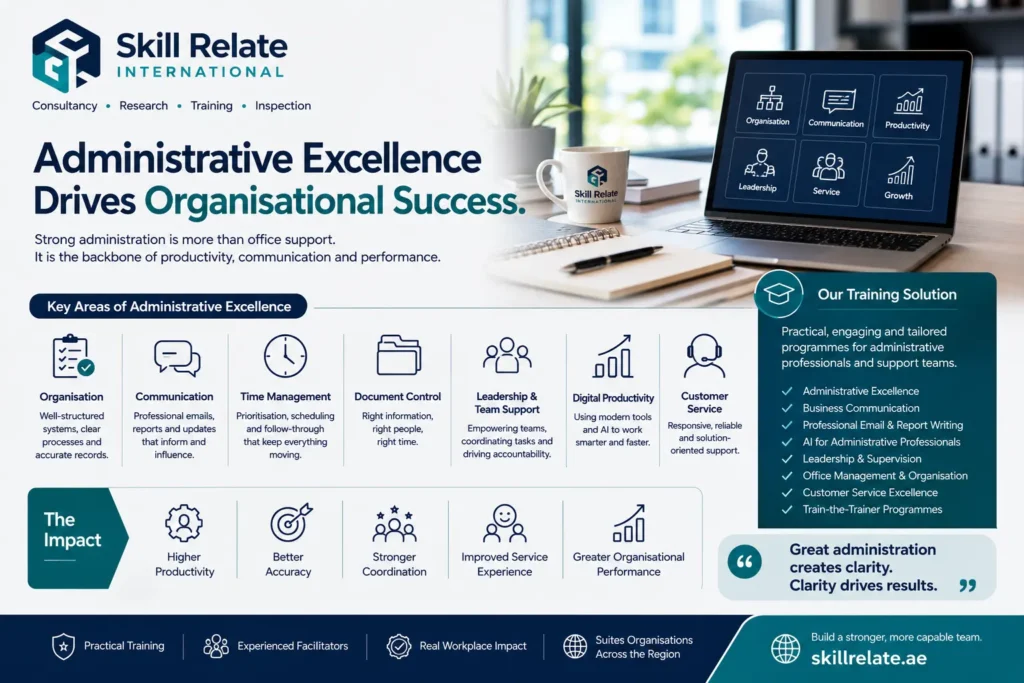
Administrative excellence is therefore not simply about completing routine tasks. It is a strategic organisational capability.
Why administrative capability matters
Every organisation depends on effective coordination.
A missed action point can delay a project. An unclear email can create confusion. Poorly prepared meeting minutes can weaken accountability. Inconsistent document control can create audit, operational and compliance risks.
Strong administrative capability helps organisations:
- improve internal communication;
- reduce delays and duplication;
- maintain reliable records;
- strengthen meeting follow-up;
- support better managerial decisions;
- improve customer and stakeholder experience;
- protect confidential information; and
- create more consistent ways of working.
Administrative excellence directly affects organisational performance.
Five common administrative weaknesses
1. Communication without clarity
Emails, reports and meeting notes may contain information, but they do not always communicate clear action.
Effective administrative communication should make the following points immediately understandable:
- what is required;
- who is responsible;
- what decision has been made;
- what the deadline is; and
- what should happen next.
Clear communication reduces unnecessary follow-up, misunderstanding and avoidable delay.
2. Weak task and action tracking
Many actions are agreed during meetings but are not followed through consistently.
A reliable action-tracking system should identify:
- the agreed action;
- the responsible person;
- the deadline;
- the current status;
- any dependencies; and
- the next review point.
This creates accountability and prevents tasks from disappearing after meetings.
3. Inconsistent document management
Poor document control can lead to:
- multiple conflicting versions;
- missing records;
- incorrect file names;
- unclear ownership;
- restricted information being shared improperly; and
- difficulty locating evidence when required.
Professional document management requires clear naming conventions, version control, filing structures, access arrangements and document ownership.
4. Reactive time management
Administrative teams are often expected to respond quickly to urgent requests.
However, constant urgency can create poor prioritisation and reduce the time available for important work.
Effective time management involves:
- distinguishing urgent work from important work;
- planning recurring responsibilities;
- protecting time for focused tasks;
- anticipating deadlines;
- managing interruptions professionally; and
- escalating unrealistic workloads early.
5. Limited use of digital and AI tools
Digital tools can reduce repetitive work, but only when they are used with a clear purpose.
Administrative teams can use technology to support:
- task management;
- document organisation;
- meeting scheduling;
- progress tracking;
- report preparation;
- internal communication;
- data handling; and
- knowledge management.
AI tools can also support email drafting, summarisation, meeting notes, report structuring and action planning, provided outputs are checked and confidentiality is protected.
What administrative excellence looks like
Administrative excellence is visible when:
- communication is clear and professional;
- records are accurate and easy to locate;
- meetings lead to documented decisions and actions;
- deadlines are monitored;
- managers receive reliable information;
- customers receive timely responses;
- processes are consistent;
- digital tools are used effectively; and
- staff understand their responsibilities.
It is not about creating more paperwork.
It is about making work easier to coordinate, monitor and improve.
Key capability areas
Professional communication
Administrative professionals should be able to prepare:
- clear and concise emails;
- structured business reports;
- accurate meeting minutes;
- executive summaries;
- stakeholder updates; and
- action-oriented correspondence.
Professional communication improves credibility and enables faster decision-making.
Office and workflow coordination
Strong coordination includes:
- calendar management;
- meeting preparation;
- task tracking;
- document organisation;
- follow-up systems; and
- communication across departments.
These capabilities reduce delays and improve continuity across the organisation.
Digital productivity
Administrative teams should be confident in using digital tools for:
- collaboration;
- scheduling;
- spreadsheet management;
- progress tracking;
- document control;
- online meetings; and
- workflow management.
Technology should simplify work rather than create additional complexity.
Customer service
Administrative professionals often represent the first point of contact for an organisation.
They therefore need skills in:
- professional communication;
- understanding customer needs;
- managing expectations;
- responding to enquiries;
- complaint handling;
- service recovery; and
- maintaining a positive service experience.
Leadership and supervision
Senior administrators, office managers and team leaders may also need capability in:
- delegation;
- feedback;
- performance support;
- conflict management;
- decision-making;
- workload coordination; and
- team accountability.
AI can strengthen administration when used responsibly
AI can improve administrative productivity, but it should not replace human judgement.
Useful applications include:
- drafting routine emails;
- summarising documents;
- preparing meeting agendas;
- converting notes into action lists;
- improving report structure;
- creating templates; and
- organising information.
However, AI outputs may be inaccurate, incomplete or unsuitable for the intended context.
Responsible use requires employees to:
- verify every output;
- avoid entering confidential or sensitive information;
- follow organisational policies;
- retain responsibility for the final document; and
- apply professional judgement before information is shared.
AI should support administrative capability, not weaken accountability.
Administrative training should be practical
Effective administrative training should be based on real workplace tasks.
Participants should practise:
- rewriting unclear emails;
- preparing concise reports;
- recording meeting decisions;
- developing action trackers;
- organising documents;
- prioritising competing workloads;
- handling difficult customers; and
- using AI tools responsibly.
Training becomes more valuable when participants leave with templates, checklists and tools they can apply immediately.
How Skill Relate International supports organisations
Skill Relate International provides customised administrative business training in areas including:
- administrative excellence;
- office management and coordination;
- professional email writing;
- business report writing;
- meeting minutes and action tracking;
- time management and prioritisation;
- digital productivity;
- document control;
- AI for administrative professionals;
- customer service;
- project coordination;
- leadership and supervision; and
- train-the-trainer development.
Programmes can be delivered in person, online or in hybrid format and tailored to the organisation’s sector, staff level and operational priorities.
Stronger administration creates stronger organisations
Organisations often invest in strategy, technology and leadership while overlooking the administrative systems that support daily execution.
Yet strategy depends on follow-up. Leadership depends on reliable information. Customer service depends on timely communication. Quality depends on consistent documentation.
Administrative excellence connects these elements.
Better administration creates clearer communication, stronger accountability and more reliable performance.
To discuss customised administrative business training, visit skillrelate.ae.