
Artificial intelligence is now being introduced across almost every organisational function.
Employees are using generative AI to draft emails, summarise documents, prepare reports, analyse information and support customer communication. Leaders are exploring AI for productivity, innovation and decision-making. Departments are purchasing tools and launching pilot initiatives.
Yet access to AI does not automatically create transformation.
When organisations adopt AI without a clear strategy, they may introduce new risks, duplicate expenditure, create inconsistent practices and fail to achieve meaningful value.
The central question is therefore not:
Which AI tool should we purchase?
It is:
What organisational problem are we trying to solve, and are we ready to use AI responsibly and effectively?
AI adoption often begins with tools rather than purpose
Many organisations begin their AI journey by selecting a platform or allowing teams to experiment independently.
Experimentation can support learning, but it should not replace strategy.
Without clear direction, different departments may:
- use unrelated AI tools;
- apply inconsistent standards;
- expose confidential information;
- produce outputs that are not properly verified;
- duplicate subscriptions and initiatives;
- automate unsuitable processes; or
- struggle to demonstrate any measurable benefit.
A tool-first approach may create activity, but activity is not the same as organisational value.
Successful AI adoption begins with a clear purpose, defined priorities and an understanding of organisational readiness.
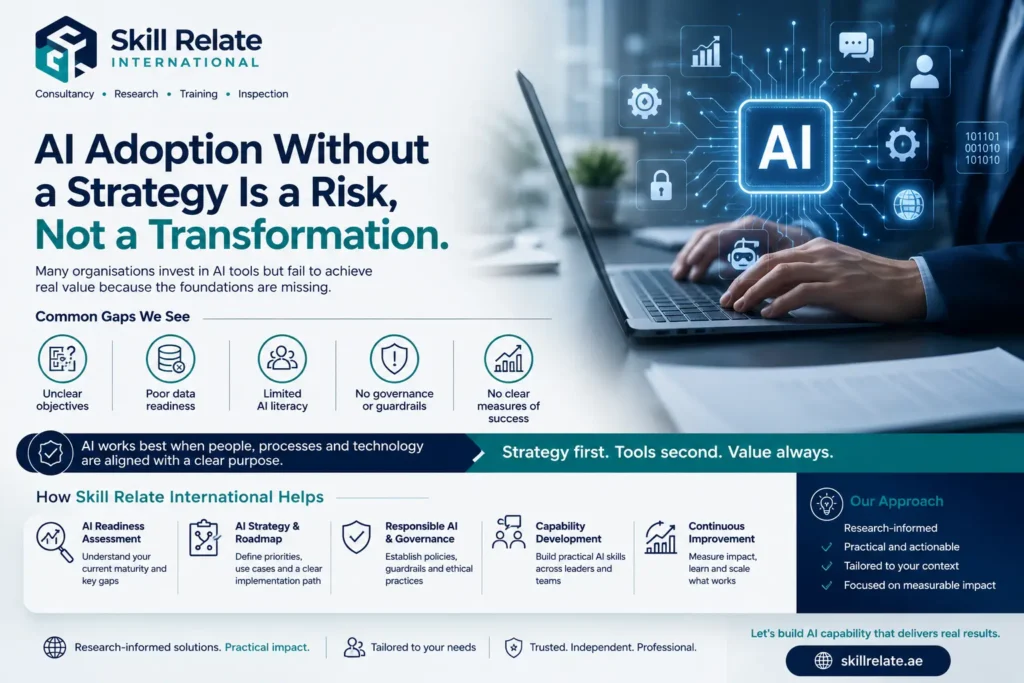
Five common gaps in AI adoption
1. Unclear objectives
Organisations sometimes describe their goal simply as “using AI” or “becoming AI-enabled”.
These are ambitions, not operational objectives.
A useful AI objective should identify:
- the problem to be addressed;
- the process or function involved;
- the expected benefit;
- the people affected;
- the risks that must be controlled; and
- the evidence that will demonstrate success.
For example, “introduce AI into administration” is too broad.
A clearer objective might be:
Reduce the time required to prepare routine internal reports while maintaining accuracy, confidentiality and managerial review.
This creates a more credible basis for selecting tools, designing workflows and measuring impact.
2. Poor data and process readiness
AI cannot correct every weakness in an organisation’s information or processes.
If documents are inconsistent, data is unreliable, responsibilities are unclear or workflows are poorly defined, adding AI may accelerate existing problems rather than solve them.
Before implementation, organisations should examine:
- data quality;
- document availability;
- access permissions;
- process consistency;
- information ownership;
- existing technology;
- integration requirements; and
- confidentiality risks.
AI readiness therefore depends on organisational foundations, not only technical capability.
3. Limited AI literacy
Employees do not need to become software engineers to use AI effectively. They do, however, need sufficient AI literacy to understand:
- what AI can and cannot do;
- how prompts influence outputs;
- why outputs may contain errors;
- when verification is necessary;
- what information should not be entered;
- how bias may affect results; and
- where human judgement remains essential.
Without capability development, employees may either avoid AI completely or use it with excessive confidence.
Both responses limit organisational value.
4. No governance or guardrails
AI governance does not need to begin as a highly complex technical framework.
Organisations can start with practical questions:
- Which AI tools may staff use?
- What information may be entered?
- Which outputs require human review?
- Who remains accountable for decisions?
- How should errors or risks be reported?
- How will the organisation review new use cases?
- What records should be retained?
- How will quality and fairness be monitored?
Clear guidance enables responsible experimentation without allowing unmanaged use.
5. No agreed measures of success
AI initiatives are often described as successful because a tool was launched, staff attended training or a pilot was completed.
These are implementation activities rather than outcomes.
Success measures should reflect the purpose of the initiative and may include:
- time saved;
- reduction in repetitive work;
- improved response time;
- fewer documentation errors;
- increased service consistency;
- improved staff confidence;
- stronger customer experience;
- improved decision quality; or
- reduced operating cost.
Where appropriate, organisations should establish a baseline before implementation so that progress can be assessed meaningfully.
What an effective AI strategy should include
An organisational AI strategy does not need to be excessively long. It should, however, provide sufficient direction for leaders, managers and employees.
A practical AI strategy should address the following areas.
Organisational priorities
The strategy should connect AI initiatives to wider organisational objectives.
AI should support the strategy rather than become a separate technology agenda with no operational ownership.
AI readiness
The organisation should assess its current position across:
- leadership;
- people and skills;
- processes;
- data;
- technology;
- governance; and
- organisational culture.
This helps distinguish immediate opportunities from longer-term requirements.
Prioritised use cases
Not every possible AI application should be pursued.
Use cases should be assessed according to:
- strategic relevance;
- expected value;
- feasibility;
- data availability;
- implementation effort;
- risk;
- staff readiness; and
- measurability.
A small number of well-selected use cases is usually more valuable than a large list of unstructured ideas.
Governance and responsible use
The strategy should establish clear principles for:
- accountability;
- human oversight;
- transparency;
- privacy and confidentiality;
- output verification;
- fairness;
- risk review; and
- continuous monitoring.
Capability development
Training should be role-specific.
Senior leaders need to understand strategic opportunities and governance responsibilities. Managers need to guide implementation and monitor quality. Employees need practical skills for their daily work.
A single general awareness session is rarely enough.
Implementation roadmap
The roadmap should identify:
- short-term actions;
- pilot initiatives;
- responsible owners;
- training requirements;
- governance milestones;
- technology decisions;
- expected outcomes; and
- review points.
This turns ambition into a manageable programme of work.
Strategy first, tools second
A credible AI initiative may follow five stages.
1. Assess readiness
Understand the organisation’s current maturity, capabilities, processes, risks and priorities.
2. Identify use cases
Select practical applications that address meaningful organisational needs.
3. Establish governance
Define appropriate use, accountability, review requirements and risk controls.
4. Build capability
Develop the knowledge and practical skills required across leadership and staff.
5. Measure and improve
Review outcomes, learn from implementation and scale only where evidence supports expansion.
This approach helps organisations avoid adopting AI simply because others are doing so.
AI strategy must remain people-centred
Artificial intelligence can support employees, but it does not remove the need for professional judgement, accountability and organisational knowledge.
Employees often understand the practical limitations of current workflows better than external technology providers. Their involvement can help identify:
- repetitive tasks;
- information bottlenecks;
- service problems;
- quality risks;
- unrealistic automation ideas; and
- opportunities for genuine improvement.
People should therefore be involved in use-case identification, pilot design, testing and review.
This also improves acceptance because employees are more likely to support change when they understand its purpose and have contributed to its design.
Responsible AI should enable adoption, not prevent it
Some organisations avoid governance because they believe it will slow innovation.
In practice, a lack of governance often slows adoption more significantly. Employees become uncertain, managers apply inconsistent rules and leaders hesitate to expand successful pilots.
Clear guardrails create confidence.
Responsible AI should provide a practical structure within which people can experiment, learn and improve while protecting organisational interests.
How Skill Relate International supports AI adoption
Skill Relate International helps organisations move from broad AI ambition to structured and responsible action.
Our AI and innovation consultancy services include:
- AI readiness assessment;
- AI strategy development;
- AI use-case identification;
- prioritised implementation roadmaps;
- responsible AI guidance;
- AI policy development;
- risk and governance review;
- benchmarking and market scanning;
- workflow improvement;
- AI training for leaders and employees; and
- adoption and capability support.
Our approach is research-informed, practical and tailored to the organisation’s context.
Build capability before scaling technology
The organisations that gain sustainable value from AI will not necessarily be those that purchase the most tools.
They will be those that:
- define clear objectives;
- understand their readiness;
- prioritise relevant use cases;
- establish appropriate governance;
- develop their people; and
- measure results honestly.
AI transformation is not achieved when a tool is introduced.
It is achieved when people, processes, governance and technology work together to produce better outcomes.
Strategy first. Tools second. Value always.
To discuss AI readiness, strategy, governance or capability development, visit skillrelate.ae.